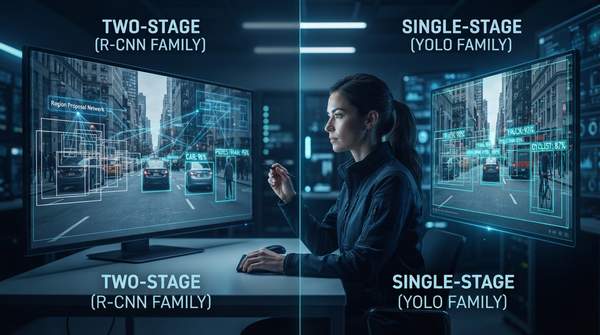
Every modern object detection system rests on the same foundation: a convolutional neural network that learns to find patterns in image pixels. What separates the major architectures is not the foundation but the strategy built on top of it. Two dominant approaches exist. Two-stage detectors, exemplified by R-CNN, first determine which regions of an image contain objects, then classify those regions in separate networks. Single-stage detectors, exemplified by YOLO, blend localization and classification into a single network pass, which is what makes them swift enough for real-time detection.
Two-Stage Object Detection: The R-CNN Approach
The two-stage philosophy treats detection as a sequence of distinct problems. As IBM's computer vision explainer describes it, R-CNN (region-based convolutional neural network) implements two-stage detection by first determining regions bearing objects, then running those regions through separate networks for classification and more exact localization. The model does not ask "what is this?" until it has already asked "where might something be?"
This separation is the architecture's defining trait. A region proposal step scans the image for candidate areas, and only those candidates move forward to a classification stage, where a second network assigns each region a label and refines the position of its bounding box. Because localization and classification are handled by distinct, dedicated steps, the pipeline can be tuned at each stage. The cost is time: every proposal must be processed, and the sequential structure means the second stage waits on the first.
The approach has evolved. IBM's object detection overview notes that Fast R-CNN and Faster R-CNN are later modifications that reduce the size of the R-CNN architecture, decreasing processing time while also increasing accuracy. Even with those refinements, the family retains its two-stage character: propose regions first, classify them second.
Single-Stage Object Detection: The YOLO Approach
YOLO (You Only Look Once) takes the opposite view: why split the problem at all? Instead of proposing regions and then classifying them, YOLO conducts single-stage detection by blending localization and classification in a single network pass, according to IBM's explainer. The entire image is examined at once, and the network predicts bounding boxes and class probabilities simultaneously.
First developed in 2016, the YOLO architecture prioritizes speed, as IBM's object detection overview recounts. YOLO is a family of single-stage detection architectures based in Darknet, an open-source CNN framework, and that speed has made it preferable for real-time object detection, earning it the common descriptor of a state-of-the-art object detector. A Medium introduction to the algorithm by Fatimazahra Belharar makes the same point: YOLO is known for its single-stage architecture and impressive performance in real-time applications.
The name itself captures the design. The network looks at the picture once, rather than cycling through candidate regions. That directness is the mechanism behind its real-time capability, and it is the clearest operational contrast with the two-stage pipeline.
Operational Comparison of Object Detection Architectures
Setting the two strategies side by side shows how the same CNN foundation leads to different engineering choices. The table below contrasts the operational stages and design philosophy of each approach, and the pattern it reveals is straightforward: two-stage detectors break detection into discrete, manageable steps, while single-stage detectors collapse those steps into one pass to gain speed.
| Dimension | Two-Stage Detectors (R-CNN) | Single-Stage Detectors (YOLO) |
|---|---|---|
| Approach | Separates object localization (bounding box proposals) from object classification. | Combines object localization and classification into a single network pass. |
| Key Steps | First identifies regions of interest, then classifies objects within those regions. | Predicts bounding boxes and class probabilities simultaneously across the entire image. |
| Example Architecture | R-CNN (region-based convolutional neural network), with Fast R-CNN and Faster R-CNN as later modifications. | YOLO (You Only Look Once), a family of architectures first developed in 2016 and based in Darknet. |
| Primary Advantage | Generally achieves higher localization accuracy, at the cost of processing speed. | Performs more quickly, making it suitable for real-time applications, with some trade-off in precision. |
One caveat belongs alongside this comparison. The speed-versus-accuracy trade-off is a general pattern, not a law: specific model versions and optimizations can shift the balance, and the comparison here is conceptual rather than a set of quantitative benchmarks.
Training Methodologies for Object Detection Models
Whichever architecture is chosen, the underlying training problem is similar: the network must learn, from labeled examples, to predict both where objects are and what they are. A review of YOLO published through the National Library of Medicine's PMC archive describes how single-stage detection is realized with the help of a multi-task loss function, in which all the network's layers can be updated during model training without any specific requirement of disk storage for caching features.
In that pipeline, the entire image is fed into the network to generate a feature map, from which a feature vector is generated for each object proposal. Each feature vector is then fed into a fully connected layer with a SoftMax activation function, which outputs class probabilities and a bounding box offset. The loss function matters because detection is a multi-task problem: the model is simultaneously scored on localization (how close its predicted boxes are) and classification (whether its labels are correct), and training adjusts the network to improve both at once.
Evaluation follows the same multi-task logic. Kili Technology's overview of the YOLO algorithm lists the standard metrics for YOLO object detection as Mean Average Precision (mAP), Average Precision (AP), and Intersection over Union (IoU), measures that capture how well predicted boxes overlap with ground truth and how reliably classes are assigned.
Choosing the Right Object Detection Approach
The decision between the two families comes down to the primary requirement of the application. Select an object detection architecture based on that requirement: prioritize two-stage methods like R-CNN for higher accuracy in static or less time-sensitive applications, or single-stage methods like YOLO for real-time performance where speed is critical. A traffic-monitoring system that classifies and locates vehicles frame by frame is the kind of use case where YOLO's single-pass design earns its reputation; a task where images can be processed at leisure favors the two-stage pipeline's more exact localization.
Whichever path is taken, verify it empirically rather than by reputation. The measurable indicator is the observed processing speed and detection accuracy of the chosen model in a specific application context, judged with the standard metrics above, mAP, AP, and IoU. Because the trade-off between speed and accuracy is general and specific model versions or optimizations may alter it, the right test is not which family the model belongs to, but how the actual model performs on your own data.