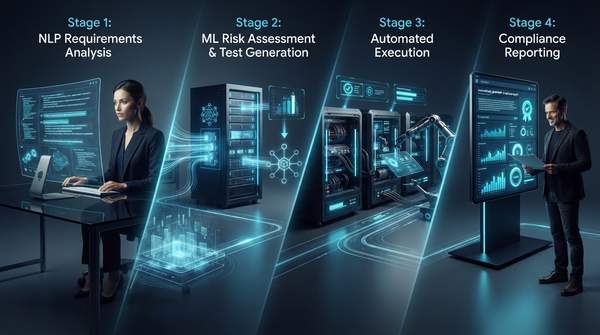
AI-powered validation software streamlines compliance and quality assurance in regulated industries by running a repeatable, multi-stage workflow: natural language processing (NLP) analyzes requirement documents for ambiguities, machine learning models predict high-risk areas from historical data, automated tools generate and execute test scripts, and the system continuously monitors performance while producing audit-ready documentation. Industry descriptions of AI-driven verification and validation, such as those from requirements-management provider Visure Solutions, frame these capabilities as enhancing "every stage of the lifecycle, from requirements authoring to certification." This article walks through each stage in sequence, so a compliance or quality professional can map the model onto their own processes.
Stage 1: Requirements Ingestion and Analysis with NLP
The workflow begins where validation itself traditionally begins: the requirements. Rather than relying on a human reviewer to read through specification documents, AI-powered tools apply NLP to understand and process the human language inside them. According to Visure Solutions' description of AI-driven V&V, automated requirement analysis uses AI algorithms to identify ambiguities, inconsistencies, and testability gaps in requirements—defects that, left undetected, propagate downstream into design, test cases, and risk records.
The practical value of this stage is that it enhances the clarity and quality of the initial requirements before any testing effort is committed. NLP helps the software parse what each requirement actually says, flagging language that is vague, contradictory, or impossible to verify. A second capability described in the same source—intelligent traceability—also begins here: machine learning models establish dynamic links between requirements, design elements, test cases, and risks, creating the traceability matrix that auditors expect without the manual cross-referencing that makes traditional validation document-heavy.
Stage 2: Predictive Risk Assessment and Automated Test Generation
Once requirements are analyzed, the workflow shifts from understanding documents to anticipating failure. Writing in DIA Global Forum, an industry publication for the drug development community, contributors describe how machine learning algorithms have the potential to proactively identify high-risk areas and evaluate the impact of software changes. The same article notes that AI can support predictive risk management by analyzing historical validation data and audit reports; with training grounded in regulatory guidance and risk-based validation literature, models can forecast high-risk areas, evaluate the effectiveness of past mitigations, and propose streamlined deliverables such as validation plans, test scripts, and summary reports.
Visure Solutions calls this component predictive validation: AI forecasts potential failure points, enabling early detection of quality and compliance risks. The consequence for the practitioner is a risk-based testing strategy that concentrates effort where failure is most likely, rather than spreading uniform effort across every function. Test generation then follows directly from the analyzed requirements and the risk profile—AI-driven tools may automate test generation and prioritize validation efforts according to risk, as the DIA Global Forum piece puts it, reducing manual scripting work while aiming to ensure comprehensive coverage of the requirement set.
Stage 3: Automated Execution and Real-time Monitoring
Execution is where the workflow becomes continuous rather than episodic. The DIA Global Forum article describes AI as automating test script generation and execution alongside continuous validation and ongoing system monitoring, with anomaly detection flagging behavior that deviates from expected patterns. This matters most for established and rapidly evolving SaaS or machine-learning-based systems, where periodic revalidation cycles struggle to keep pace with frequent changes; the article highlights continuous and adaptive validation as particularly valuable in those environments.
Real-time monitoring extends the validation verdict beyond the moment of release. Instead of treating a system as validated on the strength of a one-time test run, AI-driven tools watch system performance continuously and surface anomalies as they emerge, which supports ongoing compliance between formal validation events. The same source also notes the potential for self-healing test scripts—scripts that adapt themselves when the underlying system changes—though it presents this as a potential capability of AI-driven tools rather than an established practice, a distinction worth preserving when evaluating vendor claims.
Stage 4: Compliance Reporting and Documentation
The final stage converts the accumulated analysis, test results, and monitoring data into the documentation regulators and auditors require. Visure Solutions' description of the AI-enhanced lifecycle extends through certification, with AI automating the generation of audit-ready reports and documentation. Because the traceability links were established dynamically in Stage 1 and the test evidence was captured automatically in Stages 2 and 3, the reporting step draws on structured data rather than requiring teams to assemble validation packages by hand.
The DIA Global Forum article reinforces this direction: AI models trained on regulatory guidance can propose streamlined deliverables such as validation plans, test scripts, and summary reports. The qualification is important—these are proposals and drafts that human reviewers still govern. Indeed, the article identifies evolving models of human–AI collaboration that balance automation with expert oversight as one of the directions shaping the field, alongside regulatory harmonization across the FDA, EMA, and MHRA for continuous validation of adaptive systems within GxP workflows spanning GCP, GMP, and GLP.
AI-Powered Validation Workflow Model
The table below assembles the discrete capabilities described across the sources into a single sequential model. Read it left to right as the path data takes through the system: requirement text enters, is analyzed and linked, informs risk prediction and test generation, drives execution and monitoring, and finally emerges as compliance documentation.
| Workflow Stage | AI Technology | Key Activity | Outcome |
|---|---|---|---|
| Requirements Analysis | Natural Language Processing | AI algorithms identify ambiguities, inconsistencies, and testability gaps in requirements; ML models establish dynamic traceability links to design, tests, and risks | Clearer, higher-quality initial requirements and an automated traceability matrix |
| Risk Assessment | Machine learning on historical validation data and audit reports | Models forecast potential failure points and high-risk areas, and evaluate the impact of software changes | Proactive mitigation and risk-prioritized testing |
| Test Generation | AI-driven automation | Generation of test cases and scripts based on analyzed requirements and risk profile | Reduced manual effort with comprehensive coverage |
| Execution & Monitoring | Anomaly detection and continuous validation | Automated test execution, ongoing system monitoring, and self-healing scripts (a potential capability) | Ongoing compliance between formal validation events |
| Compliance Reporting | AI document generation | Automated assembly of audit-ready reports, validation plans, and summary reports | Streamlined documentation with reduced manual reporting burden |
Two boundaries frame this model. It describes the workflow of using AI to validate systems—not the separate, complex process of validating the AI models themselves, which the DIA Global Forum article treats as a distinct risk area. And none of it constitutes legal or regulatory advice; the sources describe capabilities and potential use cases, several of them explicitly hypothetical or emerging.
The Transformative Impact of AI Validation
Taken together, the four stages represent a shift in what validation is: from a periodic, labor-intensive documentation exercise to an ongoing, automated, data-driven process. The DIA Global Forum article situates this shift within healthcare's move toward continuous validation of adaptive systems, while Visure Solutions frames AI as enhancing the entire lifecycle from requirements authoring to certification. The recurring theme across both is precision and efficiency gained not by removing human judgment but by redirecting it—automation absorbs the mechanical work of parsing documents, generating scripts, and assembling reports, while expert oversight concentrates on risk decisions and review.
Implementing AI for Streamlined Validation
Compliance and quality assurance professionals should assess their current validation processes to identify stages where AI-powered tools, particularly those leveraging NLP for requirements analysis and machine learning for predictive risk, can introduce automation and continuous monitoring. The natural starting points are the most document-heavy and repetitive stages: requirements review, test script authoring, and report assembly. Successful implementation will be indicated by a measurable reduction in manual effort for requirements analysis and test generation, alongside improved real-time anomaly detection and faster generation of audit-ready compliance reports. Because several capabilities described here remain emerging—self-healing scripts and continuous validation of adaptive systems among them—teams should also watch the regulatory harmonization work across the FDA, EMA, and MHRA that the DIA Global Forum article identifies as the next milestone for integrating AI assurance tools into GxP compliance workflows.
Sources
- AI-Powered Verification & Validation: Achieving End-to-End Traceability and Faster Certification — Visure Solutions
- The Next AI Revolution: Computer System Validation — DIA Global Forum