
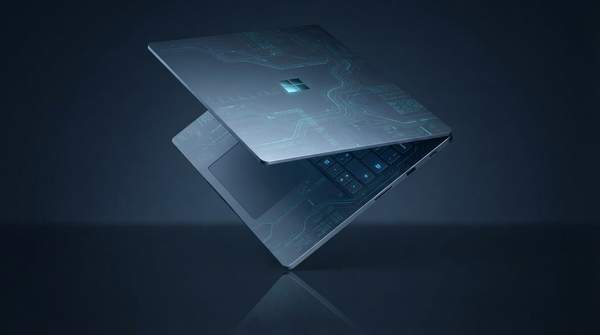
Nvidia's new RTX Spark laptop platform takes a contrarian approach to on-device AI: it skips the dedicated NPU that rivals like Qualcomm, Apple, AMD, and Intel have made central to their designs. Instead, the RTX Spark N1X chip pairs up to 20 Grace Arm CPU cores with a Blackwell GPU carrying up to 6,144 CUDA cores, backed by up to 128GB of unified memory shared between CPU and GPU. For developers already working in the CUDA ecosystem, that design unlocks local prototyping with familiar tools like TensorRT, PyTorch, and llama.cpp. The trade-offs are real, though: premium pricing and, according to early reviews, sluggish single-core CPU performance.
The RTX Spark Platform: A GPU-Centric Approach to On-Device AI
Most modern AI laptops lean on a neural processing unit—a dedicated block of silicon tuned for low-power AI inference. The RTX Spark N1X does not have one. According to Nvidia, the chip is a Grace CPU fused to a Blackwell GPU, and as Ars Technica's review of the Surface Laptop Ultra explains, the N1X "has no dedicated NPU—instead it leans on unified memory and the heavy-duty Blackwell GPU for AI work."
That is a deliberate architectural statement. Rather than splitting AI workloads between a small NPU and a general-purpose GPU, Nvidia concentrates everything on its strongest asset: the GPU. The approach is similar in spirit to AMD's Ryzen AI Max series (Strix Halo), which also uses shared memory, but Computerworld's Dave Altavilla notes the RTX Spark ships with "a more potent GPU engine on board."
Interestingly, Microsoft has bent its own rules to accommodate this design. Copilot+ certification has traditionally required a 40+ TOPS NPU, but Microsoft is extending the label to this machine's GPU-based AI performance anyway—a sign that the company sees GPU-driven AI as a legitimate alternative path.
Unified Memory and the Blackwell GPU: Powering Local AI
Why does memory matter so much here? Because large AI models need somewhere to live. PCWorld's Mark Hachman puts it plainly: memory is shared between the Arm CPU and the RTX GPU inside the N1X, and "more memory means the ability to load more powerful AI models."
That framing explains the configuration spread. RTX Spark machines ship with options ranging up to 128GB of unified memory, and Hachman observed that higher-memory configurations "encourage users to load AI agents as part of the setup process." His review unit, by contrast, arrived with 32GB—a configuration he described as disappointing for a machine carrying a $3,699 price tag.
The unified design has a second benefit: data flows between CPU and GPU without the copying overhead of traditional split-memory laptops. For AI workloads, where large tensors move constantly between processing stages, that efficiency matters as much as raw capacity.


