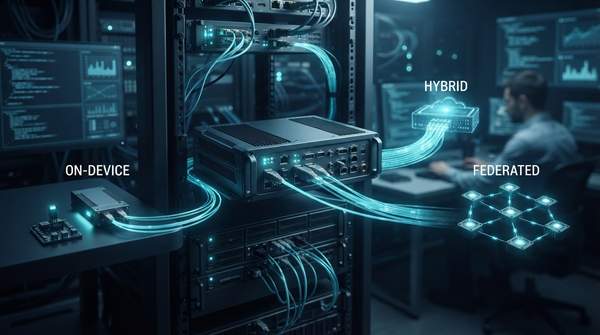
The three dominant AI accelerator architectures—GPUs, NPUs, and ASICs—differ in how much of their silicon is committed to a fixed function. GPUs are programmable parallel processors that can handle almost any model, which makes them the default for large-scale training. ASICs are custom chips built for a narrow task, trading flexibility for extreme speed and efficiency. NPUs sit in the middle as inference-focused accelerators tuned for neural network workloads, often in power-constrained edge devices. Choosing between them comes down to one question: do you need flexibility for evolving models, or efficiency for a stable, well-defined task?
Understanding AI Workloads: Training vs. Inference
Every AI chip decision starts with the workload. AI training builds models from vast datasets and, as TechTarget's guide to AI chip architectures explains, demands massive parallel processing, high memory bandwidth, and high scalability. Inference is the opposite posture: it runs a trained model on new data and benefits from extremely low latency, rapid token generation, and power efficiency.
These demands pull hardware in opposite directions. Training rewards raw throughput and the ability to scale to many chips working in concert. Inference rewards doing a fixed computation quickly, cheaply, and repeatedly—often thousands of times per second, sometimes on a battery-powered device. That distinction is why no single architecture wins both sides of the spectrum, and why vendors increasingly build accelerators for one workload rather than all of them.
GPUs: The Powerhouses of AI Training
GPUs began as graphics hardware, but their defining trait—thousands of general-purpose cores running in parallel—maps directly onto how neural networks are trained. IBM's explainer on AI accelerators and GPUs notes that GPUs are valued for their powerful parallelism, which allows many simultaneous computations, and it is precisely this design that suits the large datasets of model training. Cem Dilmegani's vendor survey for AIMultiple similarly describes GPUs as programmable parallel processors used for both training and inference.
The programmable part matters. Because a GPU can be re-targeted at new model architectures through software, it adapts as research changes direction—a recurring theme in the era of large language models. The cost is power: IBM's own assessment is blunt that GPUs suffer from high energy consumption and reduced scalability compared with narrower designs. TechTarget nonetheless rates GPUs the best overall choice for AI training because the workload's demands—parallelism, bandwidth, scalability—are exactly what GPUs were built to deliver.
ASICs: Specialized Efficiency for Specific AI Tasks
Application-specific integrated circuits abandon generality entirely. Synopsys defines AI chip design as developing chips optimized for a specific AI algorithm, workload, or use case, and ASICs are the purest expression of that idea: custom logic circuits laid out for one job and nothing else.
The payoff is efficiency. IBM's comparison observes that ASICs designed for specific applications—such as the computer vision used in self-driving cars—are faster than GPUs, and that accelerators designed for specific tasks can be anywhere from 100 to 1,000 times more energy efficient than power-hungry GPUs. That ratio translates directly into lower operational cost and reduced environmental impact for large deployments.
The constraint is equally stark. As TechTarget puts it, a processor can only operate on the instructions it is designed to support, meaning advanced processors like GPUs and ASICs are rarely able to perform general-purpose work. An ASIC's fixed function cannot be reprogrammed for a different model family; if your workload changes, the silicon does not. This makes ASICs best suited to mature, stable tasks where the model architecture has stopped moving—classic examples being inference for computer vision in autonomous vehicles.
NPUs: Edge Inference and Power-Efficient AI
Neural processing units emerged, alongside tensor processing units, to accelerate AI and machine learning workloads spanning large language models, autonomous vehicles, and healthcare use cases, according to TechTarget's architectural history. Where ASICs are defined by being custom-built for a single task, NPUs are best understood as a class of accelerator specialized for neural network computation—particularly inference—rather than for general-purpose computing.
That orientation makes NPUs a natural fit for power-sensitive edge devices. Synopsys notes that AI chip design spans everything from massive data center deployments down to power-sensitive edge devices, and each architecture is tailored to deliver the best performance and efficiency for its target application. An NPU in a phone or laptop does not train models; it runs them, trading the flexibility of a GPU for sustained, low-power inference on device.
AI Chip Architecture Comparison
The table below contrasts the three architectures on their design principle, primary workload, and central trade-off. Read it as a matching exercise: start from your workload in the left half of each row, and the trade-off column tells you what you are accepting by choosing that architecture.
| Architecture Type | Core Design Principle | Primary Use Case | Key Trade-off |
|---|---|---|---|
| GPU | Massively parallel, programmable general-purpose cores | AI training at scale; also capable of inference | High flexibility across models, but power-hungry and costly |
| ASIC | Fixed-function logic custom-built for one task | High-speed, high-efficiency inference for a specific application, e.g. self-driving computer vision | Extreme efficiency for its intended task; cannot be reprogrammed for other workloads |
| NPU | Accelerator specialized for neural network operations | Power-efficient inference, especially on edge devices | Efficiency over flexibility—built for inference, not general or training workloads |
One caveat from AIMultiple's survey deserves emphasis: architecture alone does not establish performance for a particular model. A vendor's benchmark result on one product does not validate its other products or future generations, so any selection should be verified against the specific hardware under consideration.
Architectural Trade-offs: Flexibility, Performance, and Efficiency
Seen together, the three architectures trace a single design spectrum from general to specific. The GPU buys adaptability—the same silicon runs today's transformer and, with new software, tomorrow's model family—at the price of energy consumption. The ASIC buys efficiency, with IBM reporting potential gains of two to three orders of magnitude in energy efficiency for task-specific accelerators, at the price of a design frozen at fabrication. The NPU buys a workable middle ground: neural-network specialization without full custom silicon, which suits devices where power budgets and cost constraints rule out large GPUs.
Heterogeneous design softens these trade-offs. IBM describes AI accelerators as employing an architecture in which multiple processors support separate tasks, so a single system might pair a CPU with a GPU for training work and dedicated accelerators for inference. In practice, most real AI deployments mix architectures across the pipeline rather than committing one chip type to everything.
Matching AI Chips to Your Project Needs
Choose an AI chip architecture by aligning its core design principles and trade-offs with the specific demands of your AI workload, prioritizing either training flexibility or inference efficiency. Concretely: if your project trains models from large datasets and those models may evolve, a GPU's programmable parallelism is the fit. If your workload is a stable, well-defined task running at scale, an ASIC's fixed-function efficiency wins. If you need inference on power-constrained edge hardware, an NPU is the natural candidate.
Before committing, weigh two further factors TechTarget highlights: the maturity of your models, since accelerators often only speed up a specific model's code, and the instruction sets a processor supports. Success is measurable: the project's performance metrics—training time, inference latency, power consumption—should meet your target requirements on the selected chip architecture, verified against benchmarks for that exact hardware rather than vendor claims about other products.