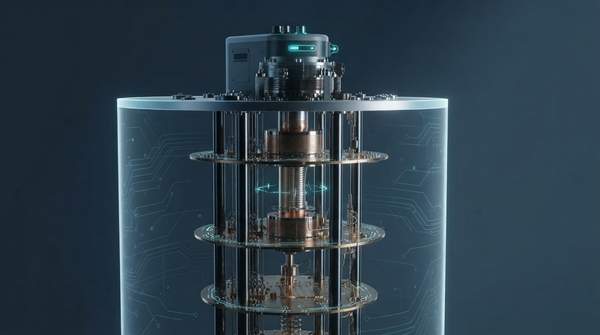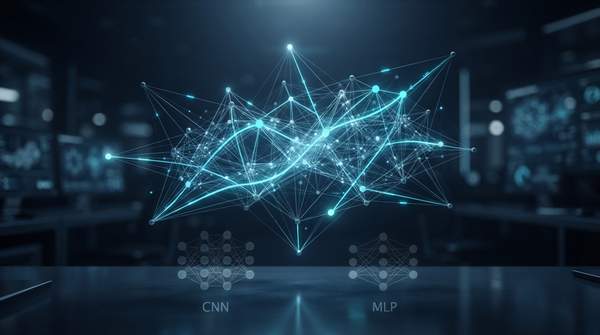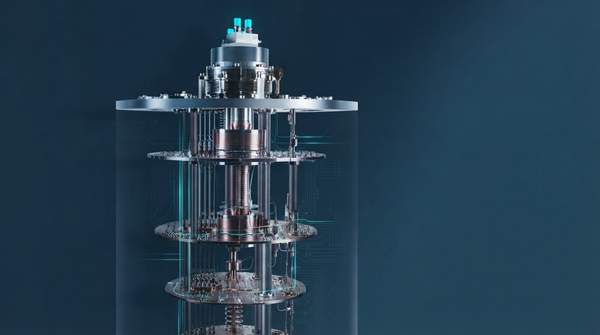
Quantum computing offers AI a fundamentally different way to compute, not just a faster one. Where classical machines grind through possibilities one at a time, quantum machines exploit superposition and entanglement to represent and manipulate many configurations at once — a property that, in theory, could dramatically speed up hard optimization problems and enable new forms of pattern recognition. The advantage is real at the level of principle and has been demonstrated in small proof-of-principle experiments, but quantum AI remains a research field, tested mainly on simulators and small-scale processors rather than deployed systems.
Understanding Quantum Computing Fundamentals for AI
Classical computers process information in bits, each of which is discretely a 0 or a 1. Quantum computers instead use qubits, which can hold a 0, a 1, or a superposition of both. As IBM's explainer puts it, a qubit can place the quantum information it holds into a state of superposition, "which represents a combination of all possible configurations of the qubit." When measured, that superposition collapses into a binary state — a zero or a one — so the quantum computation must be designed so that the answer you want is the one most likely to survive measurement.
Two principles do most of the work. Superposition lets groups of qubits create complex, multidimensional computational spaces in which hard problems can be represented in new ways. Entanglement links qubits so that their states are interdependent, producing correlations classical bits cannot replicate. According to Amazon Web Services' overview of quantum AI, quantum models use algorithms that "leverage quantum mechanics principles like superposition and entanglement in fundamentally different ways" than the linear algebra and optimization techniques of traditional AI running on classical bits.
Quantum Advantage in AI Optimization Problems
Optimization is where the conceptual case is clearest. Many AI systems — from tuning model parameters to minimizing cost functions in reinforcement learning — reduce to combinatorial optimization: finding the best combination out of an enormous set of possible configurations. AWS notes that classical algorithms struggle with such problems "due to the exponential increase in complexity." Add one more variable and the search space doubles; add fifty and it becomes astronomically large.
Quantum optimization algorithms attack this differently. By placing qubits into superposition, the machine represents many candidate configurations simultaneously, and interference effects can be engineered to amplify good solutions and suppress poor ones before measurement. Capitol Technology University's overview describes the mechanism as parallelism: quantum computers leveraging superposition and entanglement "to perform multiple calculations simultaneously," which could yield significant speedups for AI tasks involving large datasets or complex optimization. The speedup is not brute-force checking of every answer — it is a structurally different route through the problem space.
Classical vs. Quantum Approach to AI Optimization
To see where the advantage comes from, contrast the two computational strategies on a representative AI problem: selecting the best set of model parameters from a combinatorial space.
| Dimension | Classical approach | Quantum approach |
|---|---|---|
| Information unit | Bit: strictly 0 or 1 | Qubit: 0, 1, or a superposition of both |
| Search strategy | Evaluate configurations one by one, or use heuristics to sample the space | Represent many configurations simultaneously in superposition |
| Handling complexity | Exponential growth in configurations overwhelms exact methods | Multidimensional qubit spaces represent the problem in new ways; interference can favor good solutions |
| Result extraction | Direct readout of the best candidate found | Measurement collapses the superposition to a probabilistic answer, so runs are repeated |
| Practical status | Mature and widely deployed | Research phase, tested on simulators and small-scale processors |
The reasoning path is straightforward: because a classical bit holds one state at a time, a classical optimizer must iterate through the possibility space sequentially. Because a qubit in superposition contributes to a combination of all possible configurations, a quantum optimizer can in principle explore a vast possibility space concurrently — the source of the potential exponential speedup for certain optimization tasks. That speedup, however, remains theoretical for most problems of commercial interest and has so far been demonstrated only at small scale.
Quantum Classifiers: A New Approach to Pattern Recognition
Classification — assigning labels to data based on learned patterns — is the second major research direction. Quantum classifiers are algorithms that use quantum computing principles to solve classification problems, and entanglement is their distinctive resource: by correlating qubits in ways classical bits cannot, they can encode intricate patterns and correlations in data. AWS suggests this could lead to more powerful and efficient machine learning models for pattern recognition.
The appeal is conceptual as much as computational. A quantum classifier maps data into a quantum state space where entangled qubits can express correlation structures that would require elaborate classical machinery to capture. Whether that translates into better real-world accuracy is an open research question — current demonstrations run on limited datasets and small qubit counts, and the practical advantage remains unproven at scale.
Experimental Progress and Demonstrations of Quantum Advantage
There is concrete, if narrow, experimental evidence behind the theory. Research led by John Preskill and colleagues — reported in work published through Caltech and involving experiments on a Google Sycamore processor — proposed three classes of learning tasks with exponential quantum advantage and ran proof-of-principle experiments using up to 40 qubits. The mathematical analyses behind that work showed that there exist properties of an n-qubit system a quantum machine can learn efficiently, whereas the number of conventional experiments needed for the same task grows exponentially with n.
That exponential separation is the strongest form of evidence available today: a rigorously characterized task where quantum learning provably outpaces classical learning. But its scope is narrow. The advantage concerns learning about quantum systems themselves, on constrained problems, and does not establish universal superiority over classical methods for AI tasks in general.
Current Limitations and the Road Ahead for Quantum AI
The gap between principle and practice is hardware. NIST's explainer is blunt about fragility: "a stray electric or magnetic field, temperature fluctuations or even a cosmic ray can ruin a superposition or entanglement," forcing qubits to act like ordinary bits. A single qubit is worth little; useful devices need many qubits entangled while sustaining superpositions. The best machines today contain hundreds of interconnected qubits and err roughly once in every thousand operations.
A 2025 review in Nature Communications, authored by a large team including Yuri Alexeev, Alán Aspuru-Guzik and Roger Melko, frames the field's transition from noisy intermediate-scale quantum (NISQ) devices to fault-tolerant quantum computing as the central challenge. All popular qubit technologies suffer hardware noise that prevents the below-threshold operation fault tolerance requires, and even below-threshold qubits face scaling obstacles: more resourceful error-correction codes, faster decoders, and carefully designed architectures. Until those are solved, quantum AI stays in the laboratory.
The Future Trajectory of Quantum AI
Quantum computing offers a fundamentally new paradigm for AI problem-solving, particularly for optimization and classification, but its widespread practical impact is contingent on overcoming current hardware limitations. For readers deciding whether to invest attention or resources now, the honest answer is that quantum AI is a research frontier, not a production tool: the theoretical advantages are well characterized, the experimental demonstrations are small, and the engineering obstacles — noise, error rates, scaling — are severe.
The measurable indicator to watch is progress in qubit stability, error correction techniques, and the number of stable, interconnected qubits in experimental quantum processors. Today's benchmark — hundreds of interconnected qubits erring roughly once per thousand operations — is the baseline; sustained improvements in those numbers, particularly demonstrations of below-threshold error correction at increasing scale, are the concrete milestones that would signal quantum AI moving from proof of principle toward practical relevance.
Sources
- What Is Quantum Computing? — IBM
- What is Quantum AI? - Quantum AI Explained - AWS — Amazon Web Services, Inc.
- Supercharging AI with Quantum Computing: A Look into the Future — Captechu
- Preskill
- Quantum Advantage in Learning from Experiments — Research
- Quantum Computing Explained — NIST
- Artificial intelligence for quantum computing - Nature Communications