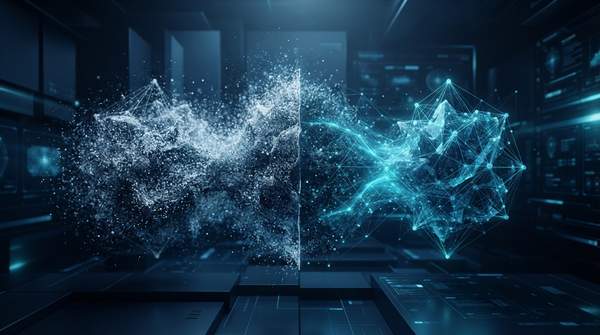
Diffusion models are a class of generative AI that creates new data by running a simple trick in two directions: first they deliberately destroy a training sample with gradually increasing random noise, then they train a neural network to undo that destruction. Once the network has learned to reverse the noising process, it can start from pure random static and "denoise" it into a coherent, entirely new sample. The approach is best known for image generation, but the same mechanism is applied to audio generation, drug design, and molecule generation.
Introduction to Diffusion Models
Generative AI has to solve a hard problem: how do you produce something new that still looks like the real thing? Diffusion models answer that question by borrowing an idea from physics. Their name comes from diffusion processes, the stochastic processes that describe how systems evolve probabilistically over time—think of a drop of ink spreading through a glass of water until it is evenly dispersed.
IBM's explainer on the topic uses exactly that ink analogy. The random movement of ink molecules eventually leads to their even dispersal in the glass. In the same way, the random introduction of noise into an image eventually results in something that looks like TV static. The insight behind diffusion models is that this one-way-looking process can be modeled and, crucially, learned in reverse.
Why does that matter? Because if a model can learn to reverse the journey from clear data to pure noise, it can start anywhere along that journey—including at the very end, where there is nothing but noise—and walk backward to produce a clean sample. As IBM puts it, an AI model can generate new images by simply "denoising" samples of random noise. Creation, in this framework, is just carefully managed noise removal.
According to Coursera's overview of the technique, the core operation is straightforward: diffusion models add random noise to existing data and then reverse the process, gradually transforming the random noise into a structured output. Through this process, the model learns to create synthetic data. No deep mathematics is needed to grasp the idea—only the two-stage loop of corrupting and reconstructing.
Diffusion models are most prominently associated with image generation and related image processing tasks such as inpainting and super-resolution, IBM notes. But the same underlying principle is not tied to pixels. Because the method only requires that data can be progressively corrupted and progressively restored, it extends naturally to other kinds of data, which is why researchers have carried it into audio and molecular domains.