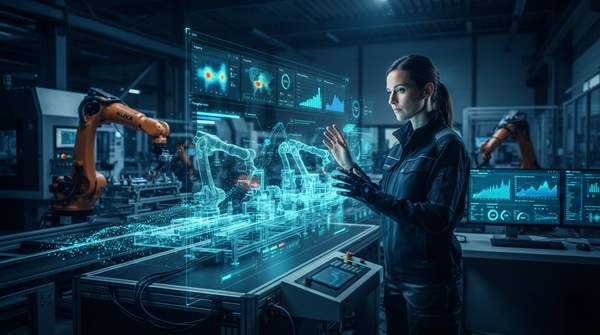
An AI-powered digital twin is a live virtual replica of a physical asset or process, continuously fed by sensor data and interpreted by AI to predict failures and optimize operations. The technology is real and already running at plant scale—but most deployments happen in brownfield factories, where legacy machines, heterogeneous controllers, and incomplete data infrastructure make implementation hard. Before committing budget, manufacturing leaders can run a structured readiness diagnostic across four dimensions: data, integration, cost, and skills.
Understanding AI-Powered Digital Twin Architecture in Manufacturing
Think of the architecture as three connected layers. At the bottom sits the physical plant: machines fitted with sensors, PLCs, and IoT devices that stream condition data—vibration signatures, thermal patterns, acoustic emissions—continuously. This is the ingestion layer, and it is what makes the twin "live" rather than a static CAD model.
The middle layer is the virtual model itself. It mirrors the physical counterpart dynamically, reflecting plant activities in real time. A review of AI-driven digital twins across manufacturing system levels describes these systems as symbiotic: the virtual model and the AI that analyzes it are inseparable, with sophisticated algorithms processing complex, high-dimensional datasets into actionable insights for optimization and decision-making.
The top layer is where the value appears. Industrial AI acts as the brain, turning raw operational data into predictions and automated decisions. Instead of waiting for monthly reports or reacting to breakdowns, manufacturers gain a continuous stream of insights from the machine level up to the entire enterprise, as maintenance-technology vendor OXMaint describes it. One caveat worth noting from the academic review: pushing for greater accuracy in twin-based prediction often comes at the expense of transparency—advanced models are harder to explain.