
All Stories

How Microsoft's Probabilistic Bias Correction Fixes the Two-to-Six-Week Weather Forecast Gap
Microsoft's Probabilistic Bias Correction (PBC) framework uses machine learning to fix systematic errors in weather models, significantly improving forecast accuracy in the crucial two-to-six-week subseasonal window. This advancement helps farmers, resource managers, and disaster responders make better-informed decisions.

Nvidia RTX Spark Laptops: A GPU-First Bet on Local AI Development
Nvidia's RTX Spark laptops adopt a GPU-first strategy for on-device AI development, leveraging unified memory and the CUDA ecosystem. This approach offers local prototyping benefits and cost efficiency for developers, though it comes with premium pricing and potential CPU performance trade-offs.

Can You Copyright AI-Assisted Work? The U.S. Human Authorship Test, Explained
In the United States, copyright protection for AI-assisted work hinges on human creative control. Purely AI-generated content is not copyrightable, as prompts alone do not establish authorship.

How AI Enhances Learning: Personalization, Feedback, and Teacher Support—Plus the Risks to Weigh
Artificial intelligence enhances education by personalizing learning, providing instant feedback, and supporting teachers, but its integration requires careful consideration of ethical risks such as data privacy and algorithmic bias.

Tired of Tool Overload? Here’s How ClientSilo Unifies Your Entire Sales Stack
Sales teams often struggle with "tool overload," juggling multiple disconnected applications that lead to data silos, wasted time, and high costs. ClientSilo offers a solution by unifying the entire sales stack into one platform, improving productivity and efficiency.

How Vision-Language-Action Models Turn Robot Perception Into Physical Movement
Vision-Language-Action (VLA) models unify perception, language, and action within a single transformer architecture, enabling robots to perform complex physical tasks in unstructured environments. This article explores their architecture, key models, and the challenges and future directions for real-world deployment.

Where AI Actually Creates Value in Precision Medicine: A Stage-by-Stage Map
Artificial intelligence delivers value in precision medicine by applying distinct techniques across five stages: data integration, diagnosis, treatment planning, drug development, and health monitoring. A company's success hinges on its targeted stage, data integration capabilities, and clinical validation, not just the "AI" label.

How AI Video Analytics Turns Camera Footage Into Business Decisions
AI video analytics transforms passive camera footage into proactive business tools by extracting actionable insights using computer vision and machine learning. This guide offers a framework for evaluating platforms based on integration, privacy, and performance to make informed decisions for operational improvements.

Choosing an AI Procedural Content Generation Algorithm: Control, Novelty, and Cost
Choosing an AI procedural content generation (PCG) algorithm for games hinges on balancing the need for predictable, curated content versus surprising, emergent variety, alongside available resources like data, compute, and tuning. The article compares Generative AI, Search-Based PCG, and Classic/Rule-Based methods to guide this decision.

Aiming Fluid Golf's Don't Suck™ Headcovers vs. Stock Covers: An Honest Comparison
This article compares standard stock golf headcovers with the aftermarket Don't Suck™ headcover, focusing on protection, aesthetics, and golfer personalization. While stock covers offer basic protection and promote the brand, premium aftermarket options provide enhanced fit, durability, and a chance for golfers to express their personality.

Foundation Models Explained: The Adaptable AI Engines That Go Far Beyond Text
Foundation models are a new paradigm in AI, representing large, adaptable engines trained on broad data that can be applied to diverse tasks across modalities, not just text.

Foundation Models Explained: Why Transformers Handle Language and Diffusion Models Paint Pictures
Foundation models are large neural networks trained on broad datasets, serving as versatile bases for numerous tasks. Two dominant architectures, Transformers for language and Diffusion models for images, define their capabilities and inherent risks like bias and hallucination.
How AI Worms Propagate: The Full Lifecycle, From Adaptive Exploits to Autonomous Inference
AI worms represent a new generation of self-replicating malware that uses large language models to adaptively exploit diverse vulnerabilities and autonomously set up inference on compromised hardware. This four-stage propagation cycle, from adaptive exploitation to autonomous inference, challenges traditional patching defenses, necessitating new containment strategies.

AI Digital Twins in Manufacturing: How They Work, What Blocks Them, and How to Know If You're Ready
AI-powered digital twins offer manufacturers live virtual replicas for optimizing operations and predicting failures, but successful implementation hinges on addressing data quality, system integration, cost, and skills. The article provides a readiness diagnostic to guide strategic decision-making.

The Ultimate Guide to Social Dining: How The Menu-Order AI App Is Redefining the GLP-1 Lifestyle
GLP-1 medication users dine out more frequently but often struggle with deciphering restaurant menus for their specific dietary needs. The Menu-Order AI app addresses this challenge by providing proactive, specialized guidance to transform dining anxiety into confident decisions.
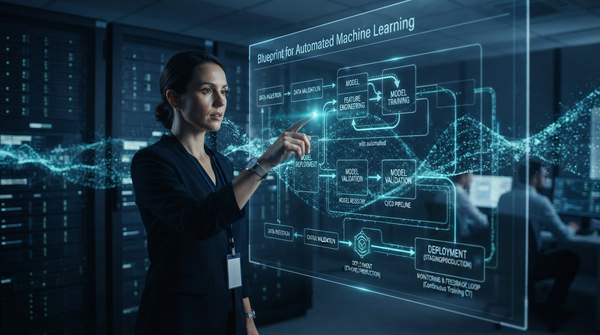
The Blueprint for Automated Machine Learning: Understanding MLOps Architecture and Workflow
MLOps applies DevOps principles to machine learning, automating lifecycles through CI/CD/CT workflows and specific architectural components. This ensures reliable model development, deployment, and continuous retraining for evolving data.

How to Value an AI Startup Beyond Revenue: A Framework for IP and Data Moats
Valuing AI startups requires looking beyond revenue to assess proprietary technology and exclusive datasets. This article outlines a framework for evaluating Intellectual Property (IP) and Data Moats as key drivers of premium valuations.

AI-Generated Art: A Guide to U.S. Copyright Law and Ethical Use
This guide examines the U.S. Copyright Office's stance on AI-generated art, emphasizing the necessity of human authorship for copyright protection, and explores the broader ethical landscape beyond legal frameworks.

Wind vs. Solar: The Distinctive Roles of AI in Predictive Maintenance
Artificial intelligence transforms renewable energy asset management through predictive maintenance, but its application differs significantly between wind turbines and solar farms. While both benefit from reduced downtime and costs, AI focuses on mechanical health for wind and electrical integrity for solar, requiring tailored data inputs and fault detection methods.

Brad Sugars’ Reputation as a Business Educator Comes From Teaching Owners How to Think
Brad Sugars' reputation as a business educator stems from teaching owners how to think more clearly about growth, money, systems, leadership, and freedom, rather than just delivering information. His methodology focuses on changing behavior, practical application, and connecting business success to an owner's personal life and goals.

How Homomorphic Encryption Lets AI Analyze Your Data Without Seeing It
Homomorphic encryption is a cryptographic technology that allows computations to be performed directly on encrypted data, enabling artificial intelligence and other analytics to process sensitive information without ever decrypting it. This approach fundamentally changes how data privacy is managed, particularly in fields like healthcare and finance, by protecting information even while it is actively in use by third-party systems.

The Ethical and Policy Challenges of Autonomous Weapons
Lethal autonomous weapons systems (LAWS) present complex international governance challenges, raising fundamental questions about human control, moral responsibility, and the future of warfare. Policymakers and ethicists are grappling with establishing regulatory frameworks to address the profound ethical dilemmas posed by delegating lethal decisions to machines.

How Knowledge Graphs Make AI Answers More Accurate
This article explains how integrating knowledge graphs into Retrieval-Augmented Generation (RAG) systems significantly enhances AI's factual accuracy and reasoning capabilities. By moving beyond unstructured text, knowledge graphs provide a structured foundation that reduces AI hallucinations and improves reliability.

Choosing AI Creative Tools: Integration and Commercial Licensing Compared
Choosing AI creative tools requires evaluating their integration into existing workflows and the clarity of their commercial licensing terms. This comparison examines key tools like Adobe Firefly, Jasper AI, Murf AI, and Stable Diffusion to guide professionals in making informed decisions.